 Publication Date : Apr 22/2026
If you run a business today, you already know that Google Reviews matter. They help customers decide where to eat, shop, or book services.
But in 2026, online reviews do more than influence people: they influence AI.
So the big question is: do Google reviews influence AI search?
Short answer: yes, more than ever.
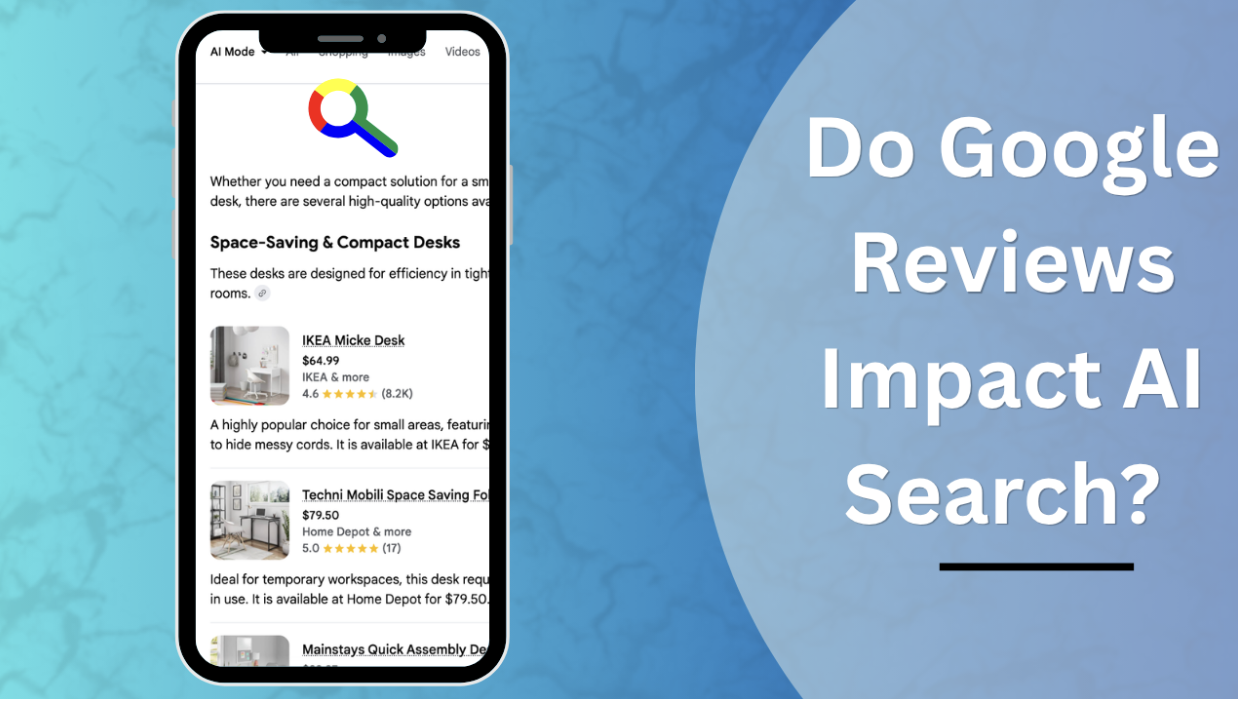
AI-powered search is changing how people find businesses. Instead of just showing links, search engines now summarize information, recommend businesses, and even answer questions directly.
And a huge part of that information comes from reviews.
Let’s break down exactly how this works and what you can do about it, as well as how you can get more Google Reviews.
Reviews Aren't Just Social Proof — They're AI Search Fuel
For years, Google reviews were mainly about trust. More stars meant more clicks. More positive comments meant more conversions.
Now, reviews are something else entirely: they’re content that feeds AI systems.
When someone asks an AI search tool something like:
“Best plumber near me with fair pricing”
Or
“Top-rated coffee shop with fast service”
The AI doesn’t just look at your website. It scans reviews to understand:
-
What people say about your service
-
Common keywords customers use
-
Sentiment (positive, negative, neutral)
-
Specific strengths and weaknesses
Your reviews become raw data that AI uses to describe your business. That means every review is not just feedback; it’s part of your digital identity.
The Traditional Power of Online Reviews
Before Google AI mode and AI search options, reviews already had a strong impact on local SEO and conversions.
Businesses with more positive reviews typically saw:
-
Higher rankings in Google Maps
-
Better click-through rates
-
Increased customer trust
-
More conversions both online and offline
Google has long used reviews as a ranking factor. Quantity, quality, and recency all play a role.

For example, a business with 300 recent 5-star reviews will almost always outperform one with 20 outdated reviews, even if both offer similar services.
Reviews also influence keywords naturally. Customers describe your business in their own words, which helps Google understand what you do.
But now, AI takes this a step further. If you haven’t begun considering how your reviews and AI connect, now’s the time.
The AI Search Shift: Reviews as Content for Summaries
AI search doesn’t just rank: it summarizes.
Instead of showing a list of links, it might say:
“This restaurant is known for fast service, friendly staff, and affordable prices based on customer reviews.”
And where does that summary come from? Mostly from reviews. Check out what Google does below.

AI models analyze large sets of review data and extract patterns. If many customers mention “quick service” or “great customer support,” those phrases get pulled into summaries.
This means:
-
Reviews directly shape how your business is described
-
Repeated phrases become your brand identity in AI results
-
Negative patterns can also surface quickly
In other words, AI doesn’t just count reviews. It reads them and uses the information accordingly in descriptions and other places online.
Chrome's AI Review Summaries: A Game-Changer for Website URLs
One of the biggest shifts is happening inside browsers like Chrome.
When users search or visit certain pages, AI can now generate review summaries directly tied to business listings and URLs.
This changes everything.
Instead of users scrolling through dozens of reviews, they see a quick summary like:
“Customers frequently mention reliable service and fast response times, though some note higher pricing.”
That summary becomes the first impression.
Even if your website is strong, AI-generated summaries can influence whether someone clicks, calls, or leaves.
This also means your Google Business Profile and review ecosystem are now tightly connected to how your website performs in search.
Your Google reviews now have a larger reach and could potentially inform your business description, which means you want to focus on having good ones.
Why Positive Online Reviews Matter More Than Ever
Positive Google reviews have always been valuable, but now they carry even more weight.
Here’s why:
First, they train AI systems to associate your business with positive traits. If customers repeatedly mention “professional,” “fast,” or “affordable,” those words become part of your AI profile.
Second, they influence recommendation engines. AI tools often suggest businesses based on patterns in reviews, not just ratings.
Third, they help you appear in conversational queries. When people ask natural-language questions, AI looks for businesses that match those descriptions, often using review data.
Finally, strong reviews protect your reputation. A few negative trends can stand out more in AI summaries than they would in a traditional list.
In short, your reviews are now your marketing, SEO, and branding all at once.
5 Actionable Ways To Get More Positive Reviews
Getting more reviews isn’t just about asking—it’s about creating a system that works consistently.
5 Actionable Ways To Get More Positive Reviews
Getting more positive Google reviews is not about luck or hoping customers remember to leave feedback.
It comes down to building a simple, repeatable system that fits naturally into your business. When done right, asking for reviews feels like part of the customer experience, not an extra task.
You can also buy Google reviews from a trusted service like BuyReviewz to help build your credibility as you gain more customer feedback.
Below are five proven ways to consistently generate high-quality reviews that also help your visibility in AI search.
Ask at the Right Moment
Timing is one of the most important factors when it comes to getting more Google reviews. If you ask too early, the customer may not have formed a full opinion yet.
If you wait too long, the experience fades and they lose motivation. The ideal moment is right after a positive interaction, when the customer is satisfied and the experience is still fresh in their mind.
For example, this could be right after a successful service appointment, immediately after a purchase, or at the end of a positive conversation.
If a customer is already expressing appreciation, that is your signal.
Instead of letting that moment pass, turn it into an opportunity by politely asking for a review.

The key here is to make the request feel natural, not forced. A simple and friendly approach works best.
When you consistently ask at the right time, you will notice a steady increase in responses without needing to chase customers later.
Make It Easy for Customers
Even happy customers will not leave a review if the process feels confusing or time-consuming. Convenience plays a huge role in whether someone follows through.
The easier you make it, the more likely they are to take action.
This means removing every possible barrier. Provide a direct link to your Google review page so customers do not have to search for your business.
If you have a physical location, use QR codes that customers can scan instantly. If your business operates online or through appointments, include the review link in follow-up emails or text messages.
You should also guide customers clearly. Instead of saying “leave us a review,” point them exactly where to go and what to do.
A short message like “It only takes a minute, and we’d really appreciate it” helps set expectations and reduces hesitation.
When the process feels quick and effortless, more customers will complete it, especially those who might not have taken the extra step otherwise.
Train Your Team to Ask Naturally
Your team interacts with customers every day, which makes them one of your biggest assets in generating reviews. However, simply telling employees to “ask for reviews” is not enough.
Without guidance, it can come across as awkward or inconsistent.
Instead, focus on helping your team integrate review requests into normal conversations. The goal is to keep it casual and genuine, not scripted or robotic.
Customers can tell the difference, and authenticity always performs better.
You can provide examples to help your team feel more comfortable, but encourage them to adapt the wording to their own style.
For instance, after a positive interaction, they might say something like, “We’re glad everything worked out well for you. If you have a moment, we’d really appreciate a quick Google review.”
It is also important to build awareness within your team about why reviews matter.
When employees understand that reviews help grow the business, attract more customers, and even support job stability, they are more likely to participate consistently.
Respond to Every Review
Many businesses overlook this step, but responding to reviews is just as important as collecting them. When customers see that you take the time to reply, it signals that you value feedback and care about the customer experience.
This creates a positive cycle. People are more likely to leave reviews when they know their voice will be acknowledged.
It also builds trust with potential customers who are reading those reviews before making a decision.
From an AI search perspective, responses also add context. They show how you handle feedback, how you communicate, and how you resolve issues.
All of this contributes to how your business is perceived.
When responding, aim to be polite, professional, and specific. Thank customers for their feedback and reference something from their review when possible. This makes your response feel personal rather than generic.
For negative reviews, the response matters even more. Address concerns calmly, offer a solution, and show a willingness to improve.
A thoughtful response can often turn a negative situation into a positive impression for future customers. Bad Google reviews aren’t the goal, but you can turn them into something beneficial with the right strategy.
Turn Great Service Into Review-Worthy Experiences
At the core of every positive review is a strong customer experience. While asking and making it easy are important, they only work if the experience itself is worth talking about.
Focus on creating moments that stand out. This does not always mean doing something big or expensive.
Often, it is the small details that leave a lasting impression. Being responsive, respectful, and reliable goes a long way.
Pay attention to common themes in your existing reviews. If customers frequently mention fast service, friendly staff, or clear communication, those are strengths you should continue to reinforce.
If certain areas are lacking, improving them can lead to better future feedback.
You can also gently guide customers toward leaving more detailed reviews. Without being pushy, encourage them to share specifics about their experience.
Detailed reviews not only help other customers but also give AI systems more useful information to understand and recommend your business.
When you consistently deliver quality experiences and pair that with a simple review process, positive reviews become a natural outcome rather than something you have to chase.
How to Monitor and Optimize How AI Sees Your Reviews
You can’t control AI directly, but you can influence what it sees. Start by regularly reading your reviews and looking for patterns.
What words come up often?
What complaints repeat?
What strengths do customers highlight?
Those patterns are exactly what AI will notice.
You should also:
-
Track your average rating and review growth
-
Monitor competitor reviews for comparison
-
Use feedback to improve operations
-
Encourage specific, detailed reviews
Detailed reviews are especially valuable. A review that says “great service” is helpful, but one that says “fast same-day service and friendly technician” gives AI much more to work with.
Also, keep your Google Business Profile updated. Consistency between your profile, website, and reviews helps AI build a clear understanding of your business.
Final Thoughts: Do Google Reviews Influence AI Search?
Yes. Google reviews absolutely influence AI search. But it’s not just about stars anymore.
AI reads, analyzes, and summarizes reviews to shape how your business appears in search results. It uses customer language to define your brand and recommend your services.
That means every review contributes to your visibility.
Businesses that actively manage and grow their reviews will have a major advantage in AI-driven search environments.
If you ignore reviews, you’re not just missing out on social proof, you’re missing out on how AI understands your business.
FAQs
Still have some questions? Check out our FAQ before you go.
Do Google reviews affect SEO rankings in 2026?
Yes, Google reviews still play a role in local SEO rankings. Quantity, quality, and recency all influence how your business ranks in local search and maps.
With AI search, reviews also impact how your business is described and recommended.
How does AI use customer reviews in search results?
AI analyzes reviews to identify patterns, keywords, and sentiment. It uses this data to generate summaries, answer user questions, and recommend businesses based on specific needs.
What kind of reviews help the most with AI search?
Detailed and specific reviews are the most helpful. Reviews that mention services, speed, pricing, and customer experience give AI more context than short, generic comments.
Can negative reviews hurt my visibility in AI search?
Yes, especially if negative themes repeat. AI can highlight common complaints in summaries. However, responding professionally and resolving issues can reduce the impact and even improve your reputation.